
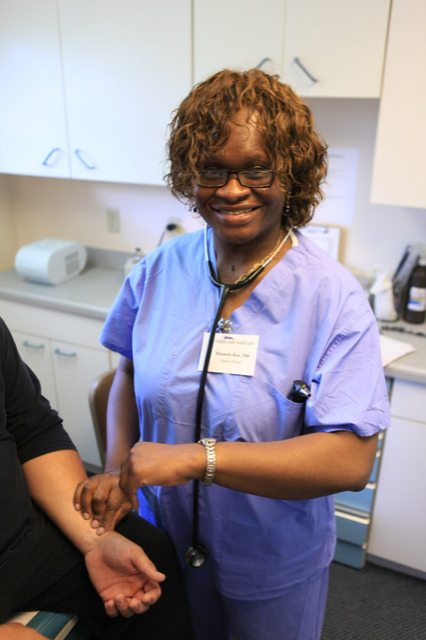
For more than three decades, I have served as a physician in underserved communities—walking alongside patients and families navigating not only illness, but poverty, trauma, and systemic barriers to care. My journey has taken me across three continents, through medical training, clinical practice, and now into community-wide systems change.
Today, I serve as a physician, community advocate, and the coordinator of the 100 Families Initiative in Ingham County—work centered on helping families move from crisis to stability through collaboration, dignity, and measurable impact.
A Calling Shaped by Service
I was born in Cameroon, trained in medicine in France, and came to the United States with a deep commitment to serve communities too often overlooked. In Lansing, Michigan, I founded His Healing Hands Clinic, providing care to uninsured and underserved individuals with a strong focus on mental health.
Over the years, I have cared for thousands of patients facing complex challenges: untreated mental illness, addiction, housing instability, and generational poverty. These experiences taught me a powerful lesson—medicine alone is not enough.
Expanding the Definition of Healing
In the exam room, I began to see patterns. Patients would stabilize medically, only to return in crisis because nothing else in their lives had changed. Housing, employment, food security, transportation, legal barriers—these social determinants of health were shaping outcomes as much as (and often more than) any prescription.
That realization led me to expand my work beyond clinical care and into holistic family support services—bringing together churches, agencies, and community partners to walk alongside families toward long-term stability.
The 100 Families Initiative: Collaboration That Changes Outcomes
The 100 Families Initiative is a collaborative, community-led effort that connects families in crisis with coordinated support. This work is built on relationship, accountability, and shared responsibility—because no single organization can meet the full range of needs families face.
What makes this model different is that it is not designed for quick fixes. It is designed for transformation.
We focus on practical needs like housing stability, employment, childcare, transportation, and access to services—while also honoring the importance of mental, emotional, and spiritual well-being.
Measured Impact, Real Results
This work is deeply relational—but it is also measurable.
Through our community collaboration, we have:
-
Served over 120 families and individuals
-
Helped one out of four move from crisis to stability
-
Achieved a 95% employment retention rate
-
Increased housing stability by nearly 200%
-
Engaged an average of four agencies per family, reducing duplication and closing gaps in support
Behind every number is a real person—and a real story—of what can happen when a community shows up together.
Leadership, Integrity, and Advocacy
Serving underserved communities requires courage, consistency, and integrity—especially when you are committed to equity and accountability. Throughout my career, I have learned that truth-telling and justice-focused leadership are not always comfortable, but they are necessary.
I remain committed to ethical leadership, due process, and advocacy that protects both families and professionals—because strong systems should be fair, transparent, and grounded in dignity.
Why Storytelling Matters
Data matters—but stories also matter.
Stories restore dignity. They humanize policy. They help communities see what is possible. As a physician and community advocate, I continue to share lessons from the field—what I am learning while walking with families, churches, and agencies committed to lasting change.
Looking Ahead
My work continues to focus on:
-
Community healthcare services
-
Family advocacy programs
-
Public health education initiatives
-
Holistic family support services
-
Housing stability assistance
-
Employment readiness and retention
-
Collaborative, community-led poverty solutions
I remain hopeful—because I see families rise when given the right support at the right time. I see agencies choosing partnership over silos. I see churches stepping into the work of restoration with compassion and action.
Healing happens when we walk together.